
Ka Mau te Wehi! Unit 13 Ko te hui-ā-whānau – Family reunion
TUnit 13 of 20. Ka Mau te Wehi! is based on levels 1 and 2 of Te Aho Arataki Marau mō te Ako i Te Reo Māori – Kura Auraki Curriculum Guidelines for Teaching and Learning Te Reo Māori in English-medium Schools: Years 1–13.

About this resource
This unit focuses on:
- Suggested curriculum link: 2.1
- Learning intentions: Learn different words for family members, where family comes from, ask about other families
- New words: Taku whānau, Nō [place], whakapapa, koro, kuia, tuakana, teina, tungāne, tuahine, ingoa, haere, hoki, marae tikanga, paepae
Ka Mau te Wehi! Unit 13: Ko te hui-ā-whānau – family reunion
See Materials that come with this resource to download Unit 13 Ko te hui-ā-whānau The family reunion (.pdf).
Learning intentions
In this unit ākonga will learn:
- to talk about where their family comes from
- the words for family members
- how to ask others about their families.
Success criteria
Before commencing the unit, the kaiako will discuss the learning intentions with ākonga and together agree on appropriate success criteria.
Resources
See Materials that come with this resource to download:
- Unit 13 transcripts (.pdf)
- Unit 13 Teacher Sheet A (.pdf)
Activity 1
Learning intention
Ākonga will talk about where they come from.
Ākonga will have the opportunity to tell other ākonga where their whānau comes from.
Round 1
Nō Te Wairarapa taku whānau. |
My family is from Wairarapa. |
Nō Tūranganui ā Kiwa taku whānau. |
My family is from Gisborne. |
If someone’s whānau is from more than one place, you can list the place and follow this with the word hoki (also). For example:
Nō Te Wairarapa, nō Tūranganui ā Kiwa hoki taku whānau. |
My family is from Wairarapa and from Gisborne. |
Round 2
Ask ākonga to imagine that their whānau is going back to their tūrangawaewae (a place called home) for a holiday. If ākonga come from more than one place, they just need to choose one for this exercise. They can take turns to tell the class where they are going. For example:
Ka hoki taku whānau ki Hāmoa. |
My family will return to Samoa. |
Ka hoki taku whānau ki Te Wai Pounamu. |
My family will return to the South Island. |
Encourage ākonga to listen carefully to what others say.
Round 3
Ākonga take turns to say where the others are going. For example:
Ka hoki a Hera ki Ahuriri. |
Hera will return to Ahuriri (Napier). |
Ka hoki a Sione ki Hāmoa. |
Sione will return to Hāmoa (Samoa). |
Ka hoki a Joe ki Ahitereiria. |
Jo will return to Ahitereiria (Australia). |
Ka hoki a Greta ki Tiamani. |
Greta will return to Tiamani (Germany). |
Round 4
Two groups join and repeat Round 3.
Activity 2
Learning intention
Ākonga will draw their family tree.
Before starting this activity, watch the He kōrero video, where whānau and kinship are discussed.
Watch: He kōrero whakamārama – Whānau/kinship
Unit 13 He kōrero whakamārama – Whānau/kinship
Draw the simple whakapapa (family tree), for your family on the whiteboard or show Unit 13 Teacher Sheet A. Write the names of the family members on the family tree and the name of that person’s relationship with you in brackets, explaining the relationships as you work. Look at the example given below in relation to Haami and the members of his whānau. When you look at the family tree from Haami’s perspective, you are able to make different statements that show the relationships between Haami and other whānau members.
Ask the ākonga to complete each of the following sentences as if they were Haami. This could be done as an oral exercise.
Ko ___________ taku pāpā. |
___________ [Dad’s name] is my father. |
Ko ___________ taku māmā. |
___________ [Mum’s name] is my mother. |
Ko ___________ taku koro. |
___________ [grandfather’s name] is my grandfather. |
Ko ___________ taku kuia. |
___________ [grandmother’s name] is my grandmother. |
Ko ___________ taku tuahine. |
___________ [sister’s name, sister of a male] is my older sister. |
Ko ___________ taku tuakana. |
___________ [older brother’s name, older brother of a male, older sister for a female] is my older brother/sister. |
Ko ___________ taku teina. |
___________ [younger brother of a male, younger sister of a female] is my younger brother. |
Ask ākonga to write the heading 'Whakapapa' and draw their family tree in their Wehi books. They should write the name of the family member’s relationship to them in Māori alongside the person’s name. They can be as detailed or as brief as ākonga wish.
Then have ākonga explain their family tree in pairs using the following sentence structure:
Ko ___________ taku pāpā. |
___________ [Dad’s name] is my father. |
Ko ___________ taku māmā. |
___________ [Mum’s name] is my mother. |
Ko ___________ taku tuahine. |
___________ [sister’s name if you are male] is my sister. |
Ko ___________ taku tungāne. |
___________ [brother’s name if you are female] is my brother. |
Ko ___________ taku koro. |
___________ [grandfather’s name] is my grandfather. |
Ko ___________ taku kuia. |
___________ [grandmother’s name] is my grandmother. |
Ko ___________ taku tuakana. |
___________ [older brother’s name if you are a boy] or [older sister’s name if you are a girl] is my same sex older sibling. |
Ko ___________ taku teina. |
___________ [older brother’s name if you are a boy] or [younger sister’s name if you are a girl] is my same sex older sibling. |
Watch: He kōrero whakamārama – Use of hoki and haere
Explains the use of hoki (return) and haere (go).
Unit 11 He kōrero whakamārama – Use of hoki and haere
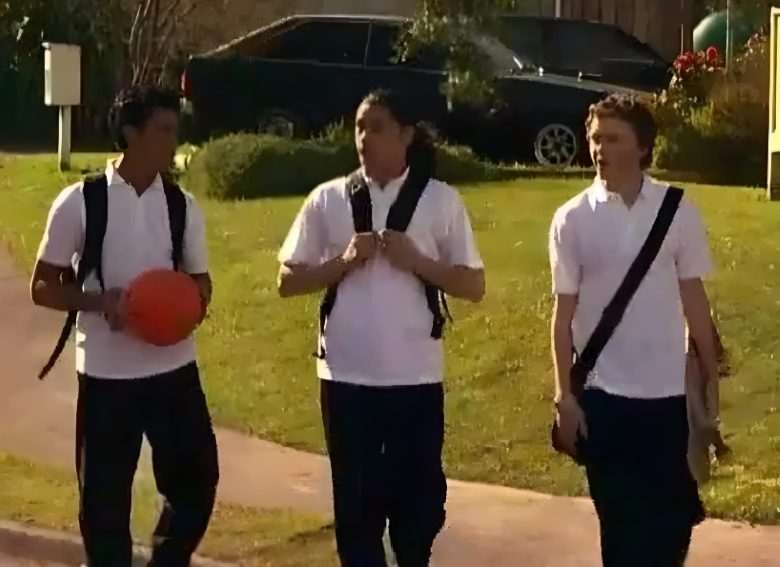
Watch: Unit 13 Scene 1 – We’re going to the family reunion
The whānau is talking about and travelling to the family reunion. Ask ākonga to listen out for the words hoki and haere.
Unit 13 Scene 1 – We’re going to the family reunion
Watch: Unit 13 Scene 2 – Are we there yet?
The tamariki are getting restless. Ask ākonga to listen out for the word tātou.
Unit 13 Scene 2 – Are we there yet?
Activity 3
Learning intention
Ākonga will revise the vocabulary they have learned so far, and they are introduced to marae tikanga – protocol of the marae.
Watch: He kōrero whakamārama – The paepae
Explains the paepae (place where the formal speakers are positioned).
Unit 13 He kōrero whakamārama – The paepae
Watch: He kōrero whakamārama – Features of a marae
Explains the features of a marae.
Unit 13 He kōrero whakamārama – Features of a marae
Watch: Unit 13 Scene 3 – Aunty Ani welcomes the family
The whānau arrives at Hongoeka marae.
Watch: Unit 13 Scene 3 – Aunty Ani welcomes the family
Hand out a copy of Unit 13 transcripts (download from the resources section above) for the scene in Māori. In small groups, have ākonga work out what the conversations are.
When they have finished, ask them to compare how well they did by showing them the English transcript. Discuss any new vocabulary or sentence structures.
Ask ākonga if any of them have family marae. Ask them to locate these on a map of New Zealand and talk about their experiences there. Encourage them to talk about tikanga – cultural aspects, on a marae, why they go to the marae, and what they do when they are there. This will provide a good introduction to the next unit.
Activity 4
Learning intention
Ākonga could talk about older and younger siblings.
Watch: He kōrero whakamārama – Use of tuakana/teina
Tuakana (older sibling of the same sex) and teina (younger sibling of the same sex) are explained.
Unit 13 He kōrero whakamārama – Use of tuakana/teina
Introduce ākonga to additional vocabulary.
Ko ______ taku koroua (ki te taha o taku māmā) |
(my grandfather on my mother’s side) |
Ko ______ taku kuia (ki te taha o taku pāpā) |
(my grandmother on my father’s side) |
Ko ______ taku tuakana |
(older brother of a boy or older sister of a girl) |
Ko ______ taku teina |
(younger brother of a boy or younger sister of a girl) |
Ko ______ taku tungāne |
(brother of a girl) |
Ko ______ taku tuahine |
(sister of a boy) |
Get them to talk about their whakapapa (family tree) to another ākonga.
Heading
Ka Mau te Wehi!
Ka Mau te Wehi! is based on levels 1 and 2 of the draft Te Reo Māori in the New Zealand Curriculum 2007. The section of the resource contains the introduction to the 20 units of work, teaching approaches and the glossary.
1 of 20Ka Mau te Wehi! Unit 1 Ata mārie – Good morning
The purpose of this unit of work is to learn the letter sounds in te reo Māori and how to greet and farewell people.
2 of 20Ka Mau te Wehi! Unit 2 - Kei te haere ki te kura
The purpose of this unit of work is to teach students how to use different ways to introduce themselves, greet others, ask others how they are and where they come from, and respond to selected greetings and questions.
3 of 20Ka Mau te Wehi! Unit 3 Where is your family from
The purpose of this unit of work is to continue the use of introductions, greetings and responses, and to learn the words for yes and no. The students will be introduced to the words whaea and nē.
4 of 20Ka Mau te Wehi! Unit 4 Waea mai - Ring me
The purpose of this unit of work is to learn to count and to ask who and where someone is.
5 of 20Ka Mau te Wehi! Unit 5 Āwhea te kanikani – When is the dance
The purpose of this unit of work is to learn the days of the week, the months of the year and to tell the time in Màori.
6 of 20Ka Mau te Wehi! Unit 6 - Kei hea tō pukapuka
The purpose of this unit of work is to learn how to ask where something is and to respond using appropriate expressions in Màori.
7 of 20Ka Mau te Wehi! Unit 7- What are you wearing to the dance?
The purpose of this unit of work is to learn the words for colours and some articles of clothing, and hear a traditional Màori legend.
8 of 20Ka Mau te Wehi! Unit 8 Titiro ki tēnei! – Look at this
The purpose of this unit of work is to learn how to ask where something is and to respond using appropriate expressions in Màori.
9 of 20Kau Mau te Wehi! Unit 9 Ko wai te toa – Who is the winner
The purpose of this unit is to learn the names of sports, buying clothing, words for woman / man and sportsperson
10 of 20Ka Mau te Wehi! Unit 10 Autaia koe – You are a champion!
This resource contains unit 10 of 20. Ka Mau te Wehi! is based on levels 1 and 2 of Te Aho Arataki Marau mō te Ako i Te Reo Māori – Kura Auraki Curriculum Guidelines for Teaching and Learning Te Reo Māori in English-medium Schools: Years 1–13.
11 of 20Ka Mau te Wehi! Unit 11 Kapa haka – Culture club
The purpose of this unit of work is to revise telling the time in Māori, understand what kapa haka is and participate in kapa haka activities.
12 of 20Ka Mau te Wehi! Unit 12 Kia kaha Aotearoa
The purpose of this unit of work is to learn the New Zealand national anthem, be able to talk about sport in Màori and learn about the tribal areas of New Zealand.
13 of 20Ka Mau te Wehi! Unit 14 Tō tātou maunga – Our mountain
Unit 14 of 20. Ka Mau te Wehi! is based on levels 1 and 2 of Te Aho Arataki Marau mō te Ako i Te Reo Māori – Kura Auraki Curriculum Guidelines for Teaching and Learning Te Reo Māori in English-medium Schools: Years 1–13.
14 of 20Ka Mau te Wehi Unit 15 Te tākaro pā whutupōro – Touch rugby
The purpose of this unit of work is to learn the Māori creation story and other Māori myths and legends. Students will also revise vocabulary around sport.
15 of 20Ka Mau te Wehi! Unit 16 He kōrero aroha – A love story
The purpose of this unit of work is to learn and develop knowledge about the maraeand marae protocol.
16 of 20Ka Mau te Wehi! Unit 17 Kua reri kōrua – Are you two ready
This resource contains unit 17 of 20. Ka Mau te Wehi! is based on levels 1 and 2 of Te Aho Arataki Marau mō te Ako i Te Reo Māori – Kura Auraki Curriculum Guidelines for Teaching and Learning Te Reo Māori in English-medium Schools: Years 1–13.
17 of 20Ka Mau te Wehi! Unit 18 Te kanikani – The dance
The purpose of this unit of work is to extend learning about likes and preferences, to learn how to talk about future time and to learn the words of a waiata.
18 of 20Ka Mau te Wehi! Unit 19 – Come to the market
Unit 19 of 20. Ka Mau te Wehi! is based on levels 1 and 2 of Te Aho Arataki Marau mō te Ako i Te Reo Māori – Kura Auraki | Curriculum Guidelines for Teaching and Learning Te Reo Māori in English-medium Schools: Years 1–13.
19 of 20Ka Mau te Wehi! Unit 20 Mā wai te haka e tātaki
The purpose of this unit of work is to learn about well-known waiata and how to perform these waiata as a group
20 of 20